
The cross-selling gap:
Only a minority of field technicians actively present additional services during service calls. The ones who do can earn 30% of their income from upsells, often pushing their annual earnings to $50,000 to $70,000. But most techs leave money on the table, visit after visit.
This guide explains why cross-selling fails, what the revenue opportunity actually looks like, and how to fix it with better training, incentives, and systems.
Want to increase technician cross-sell rates?
AutoRev AI identifies upsell opportunities during booking calls and prompts your techs before they arrive.
The Tech Mindset Problem
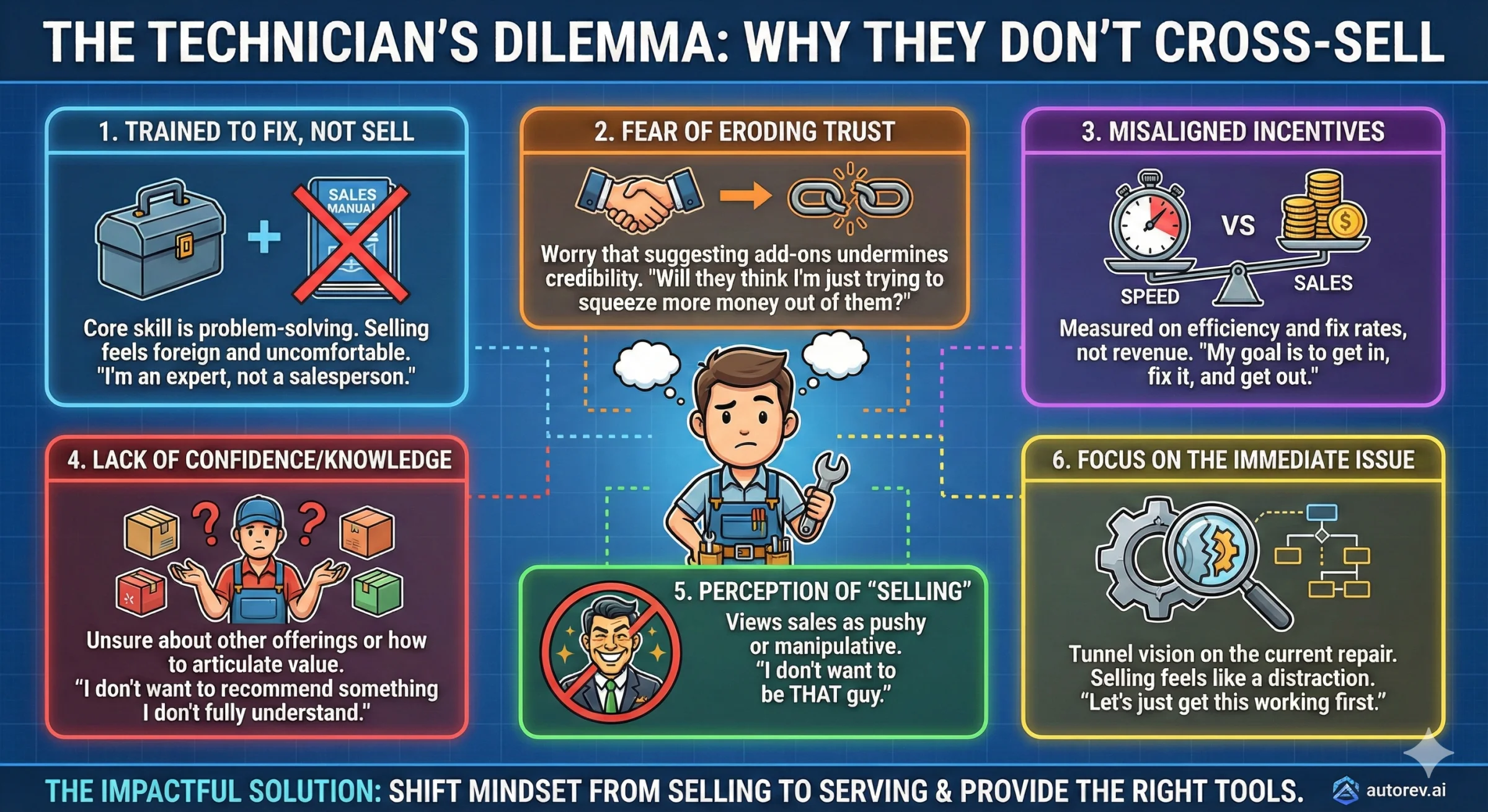
Most technicians see themselves as fixers, not sellers. They got into the trades to work with their hands, solve problems, and help people. "Sales" feels slimy.
Common tech objections:
- "I'm a technician, not a salesperson"
- "I don't want to seem pushy"
- "The customer just wants their problem fixed"
- "I don't have time to pitch extra stuff"
- "I don't know enough about pricing to quote on the spot"
These objections are understandable. Techs are not wrong that aggressive upselling feels wrong. But there is a difference between pushy sales and helpful recommendations.
When a tech notices a failing capacitor in an AC unit and mentions it before it causes a bigger problem, that is not selling. That is being thorough. The customer benefits from the heads up.
The mental shift: "I'm not trying to sell them something. I'm making sure they have all the information to make good decisions about their home."
The Four Barriers to Cross-Selling
Research and industry observation point to four main barriers that stop techs from presenting additional services:
1. Discomfort with "selling"
Techs prioritize fixes over sales due to their "technician first" mindset. Without training that reframes recommendations as service (not sales), they default to fixing only what was requested.
2. Time pressure
Emergency repairs and packed schedules leave little room for expanding the conversation. When there are three more calls on the board and the next customer is already waiting, the path of least resistance is to complete the current job and move on.
3. Poor training
Many contractors train techs on technical skills but never teach them how to naturally integrate relevant upsells into the service conversation. Without scripts, practice, and coaching, techs feel unprepared.
4. Weak incentives
If techs earn the same hourly rate whether they present additional services or not, why would they take the social risk of "selling"? Companies where 57% of technicians actively present services typically have incentive programs driving that behavior.
The Revenue You're Missing: Real Numbers
Every service call where a tech could have recommended maintenance, replacement, or add-on services represents lost revenue. Let's look at specific categories:
4.3% CAGR reflecting increasing homeowner awareness
When properly framed by trained techs
At time of service vs. later outreach
IAQ (Indoor Air Quality) Products
The U.S. IAQ market is projected to grow from $10.5 billion in 2024 to $12.9 billion by 2029 (4.3% CAGR). This growth reflects increasing homeowner awareness and attachment opportunities.
In well-trained, process-driven shops, IAQ add-ons (UV lights, HEPA filters, high-MERV filters, humidifiers) are treated as a standard recommendation category on most maintenance and many repair calls, not a rare add-on. Marketing guidance consistently describes IAQ items as among the "most profitable HVAC upsells" because they have comparatively high acceptance rates when positioned as health upgrades.
Smart Thermostat Upgrades
Smart thermostats are consistently positioned as a core, easy upsell with high homeowner interest because they combine comfort and energy savings. Contractor sales content groups smart thermostat upgrades with IAQ and filtration as "top" upsell categories techs should present on most calls.
For a tech-driven, scripted offer of a smart thermostat (especially replacing old non-programmable stats), realistic close rates fall in the 25 to 50% band for well-framed offers, the same range contractors target for accessory proposals generally.
Maintenance Agreement Attachment
Industry best practice strongly favors presenting agreements at time of service rather than later follow-up. ServiceTitan's materials on maintenance agreements focus heavily on building templates and automation so reps can present and close agreements during active deal cycles.
The data is clear: closing during a live interaction is far more effective than chasing later. HVAC sales resources consistently teach techs to sell maintenance agreements during repairs or tune-ups to lock in future visits. Later outreach is treated as "salvage" rather than primary acquisition.
Per-call revenue opportunity:
| Opportunity | Potential Revenue | Close Rate (trained tech) |
|---|---|---|
| Maintenance agreement | $150 to $300/year | 25%+ at time of service |
| IAQ product (UV light, filter upgrade) | $200 to $800 | High when demonstrated |
| Smart thermostat upgrade | $250 to $500 | 25 to 50% |
| Capacitor/contactor replacement | $150 to $300 | High when shown wear |
| Duct cleaning referral | $300 to $500 | Medium |
| Water heater mention (plumbing team) | $1,500 to $3,000 | Medium |
| System replacement conversation | $5,000 to $15,000 | Lower but highest value |
Turn Every Service Call Into an Opportunity
AutoRev AI helps your techs identify and close more cross-sell opportunities with AI-powered conversation prompts and automated follow-up.
The Math: Revenue Lift from Recommending
The data on techs who actively recommend versus those who do not is compelling:
ServiceTitan's published data shows that every 5% increase in booking rate for small companies (5 to 14 techs) equates to roughly $100,000 in extra annual revenue. This illustrates the non-linear impact of small conversion improvements on total revenue.
The same principle applies to on-site recommendations. Techs who consistently follow a recommendation process produce:
- Materially higher average ticket size per call
- Higher revenue per day with similar call counts
- Better customer relationships through thoroughness
Small improvements in conversion (whether on call booking or on-site recommendations) roll up to six-figure annual revenue gains for small-to-mid HVAC shops.
Example calculation:
A tech running 4 to 5 calls per day who presents one additional service opportunity per call creates 20 to 25 new revenue opportunities per week. Even if only 20% convert:
- 4 additional sales per week
- Average additional revenue: $300 per sale
- Weekly uplift: $1,200
- Annual uplift: $62,400 from one tech
Five techs doing the same adds $300,000+ to your top line with zero additional marketing spend.
What Top Contractors Do Differently
The contractors with the strongest tech sales numbers share common practices:
1. They frame it as service, not sales
"Before I leave, let me show you three things I noticed during my inspection that you should keep an eye on."
This is not pushy. It is thorough. The tech is providing value by helping the homeowner understand their home's systems.
2. They use structured checklists
Instead of relying on techs to remember what to look for, top contractors use inspection checklists that naturally surface opportunities. The tech is not deciding what to "sell." They are completing a standard checklist and reporting what they find.
3. They provide real-time pricing tools
Techs often avoid mentioning services because they are not sure what to quote. Mobile pricing tools and pre-set service packages remove the guesswork. The tech can say, "This capacitor looks like it's on its way out. We could replace it today for $179 if you want, or you can keep an eye on it."
4. They pay commissions on upsells
In top-performing companies, techs can earn $50,000 to $70,000 annually with 30% of income coming from upsells. This aligns incentives.
Typical commission structures:
| Structure | Amount |
|---|---|
| Upsold service revenue | 5 to 10% commission |
| Maintenance agreement sold | $25 to $50 flat bonus |
| Monthly target bonus | Tiered by achievement |
| IAQ product sold | $20 to $75 per unit |
5. They train and role-play
Nexstar and other industry training organizations offer multi-day programs specifically on tech sales skills:
- Six-step objection handling
- System evaluation presentation
- How to discuss replacement without pressure
- Visual demonstration techniques (showing dirt, wear, damage)
- Timing and delivery of recommendations
Techs who practice these conversations become comfortable with them.
6. They position tech as primary, sales as secondary
The framing matters. "You're a great technician, and part of being a great technician is making sure customers have all the information about their system." This preserves the tech's identity while expanding their responsibility.
Visual Demonstration: The IAQ Advantage
One reason IAQ products have high attachment rates in trained shops: visual demonstration.
Trade interviews describe how techs who "visually show dirt/mold and explain IAQ solutions" sell IAQ equipment as a regular part of service. When a homeowner sees the dust and debris pulled from their ductwork or the buildup on their coils, the recommendation sells itself.
Effective visual techniques:
- Show the dirty filter versus a clean one
- Photograph the inside of the air handler
- Use a phone flashlight to show buildup on coils
- Compare IAQ readings before and after (if you have meters)
The tech is not "selling." They are showing what they found and offering a solution.
"The most successful techs aren't trying to sell anything. They're simply being thorough professionals who help customers understand the full condition of their systems. When you reframe cross-selling as service, resistance drops and conversions increase."
Using Technology to Surface Opportunities
Some of the cross-selling gap comes down to information. Techs in the field often lack access to customer history, equipment age, and past recommendations.
ServiceTitan and similar platforms provide technician dashboards that surface equipment age, previous recommendations, and membership status. Techs can see that this customer's water heater is 11 years old before they even knock on the door.
AI-powered systems like AutoRev AI take this further by identifying cross-sell opportunities during the initial booking call. When a customer calls about an AC repair, the AI can ask qualifying questions that surface additional needs:
"While we're out there for the AC, is there anything else you've been meaning to have looked at? Some customers also have us check water heaters or thermostats during the same visit."
This pre-visit identification means opportunities are flagged before the tech arrives, giving them a natural conversation starter.
Post-service follow up is another automation opportunity. Systems like AutoRev can automatically follow up after service calls to present maintenance agreements, ask about additional issues the tech noted, and capture upsell opportunities the tech may have mentioned but not closed on site.
Comparing Cross-Sell Support Solutions
| Solution | Pre-Visit ID | In-Field Tools | Post-Service Follow Up |
|---|---|---|---|
| AutoRev AI | AI identifies during booking | Integrates with FSM | Automated multi-channel |
| ServiceTitan | Customer history | Tech dashboards | Manual or limited |
| Housecall Pro | Basic history | Mobile pricing | Limited automation |
| Manual process | None | Paper checklists | Phone calls |
The most effective approach combines all three: AI-powered opportunity identification during booking, field service tools that surface customer data, and automated follow up that captures opportunities techs surface but do not close.
Practical Implementation Steps
If your techs are not presenting additional services, here is how to start:
Week 1: Baseline measurement
Track how many opportunities techs are presenting. Add a field to your FSM software or have CSRs ask at booking follow up. You cannot improve what you do not measure.
Week 2: Implement inspection checklists
Create a standard checklist for every service call that includes 5 to 10 items beyond the primary repair. This systemizes opportunity identification.
Week 3: Introduce incentives
Announce a commission or bonus structure for upsells. Make it meaningful enough to change behavior but sustainable for your margins.
Week 4: Training and role-play
Spend one team meeting practicing "finding" and "presenting" conversations. Have techs practice on each other until the words feel natural.
Ongoing: Celebrate wins
When a tech sells a maintenance agreement or identifies a replacement opportunity, recognize it publicly. Success stories normalize the behavior.
The Bottom Line
Cross-selling is not about squeezing more money out of customers. It is about being thorough, proactive, and helpful.
The homeowner with the failing capacitor wants to know before it dies and leaves them without AC on the hottest day of summer. The family with the 12-year-old water heater wants to replace it on their schedule, not during a Sunday morning emergency.
Techs who present additional services are not being pushy. They are being professional. And the contractors who build systems to support this behavior see six-figure annual revenue gains without any increase in marketing spend.
Ready to Close the Cross-Sell Gap?
See how AutoRev AI identifies opportunities during booking, prompts your techs in the field, and automates follow-up to capture more revenue from every service call.
Frequently Asked Questions
Why don't technicians cross-sell or upsell during service calls?
Technicians face four main barriers: discomfort with "selling" due to their fixer mindset, time pressure from packed schedules, poor training on how to naturally present recommendations, and weak incentive structures that do not reward upselling behavior.
What percentage of technicians actively present additional services?
Only a minority of techs actively cross-sell. Companies with strong cross-sell cultures, where 57% of technicians actively present services, typically have dedicated training programs and commission structures driving that behavior.
How much can technicians earn from upselling?
Top-performing technicians can earn $50,000 to $70,000 annually, with 30% of income coming from upsells and commission. Typical structures include 5 to 10% of upsold service revenue and $25 to $50 bonuses per maintenance agreement.
What are the most profitable cross-sell opportunities?
IAQ products (UV lights, HEPA filters) are described as among the "most profitable HVAC upsells" with high acceptance rates. Smart thermostats close at 25 to 50% when properly presented. Maintenance agreements sold at time of service convert far better than later outreach.
How much revenue do contractors lose from missed cross-sell opportunities?
Each service call represents $150 to $15,000 in potential cross-sell revenue depending on the opportunity. ServiceTitan data shows that every 5% improvement in conversion equates to roughly $100,000 in extra annual revenue for small contractors.
How can technology help with technician cross-selling?
AI-powered platforms like AutoRev AI identify cross-sell opportunities during the initial booking call, flagging them before the tech arrives. ServiceTitan provides tech dashboards with customer history and equipment age. Automated follow-up systems capture opportunities that techs surface but do not close.