I'm about to do something stupid from a marketing perspective. I run an AI automation company. I sell AI voice agents. My livelihood depends on you believing AI is valuable.
And I'm here to tell you that most AI automation is complete BS.
The AI Hype Machine Is Out of Control
Open LinkedIn right now. Scroll for 30 seconds. You'll see:
- "AI agents that 10x your productivity"
- "Automate your entire business with AI"
- "This AI tool replaced my whole team"
- "I built a $50k/month business using only AI"
It's exhausting. And most of it is either exaggerated, cherry-picked, or outright fabricated. Here's what's actually true: AI is a tool. Some tools are useful for some jobs. Most AI products being sold to small businesses right now are solutions looking for problems.
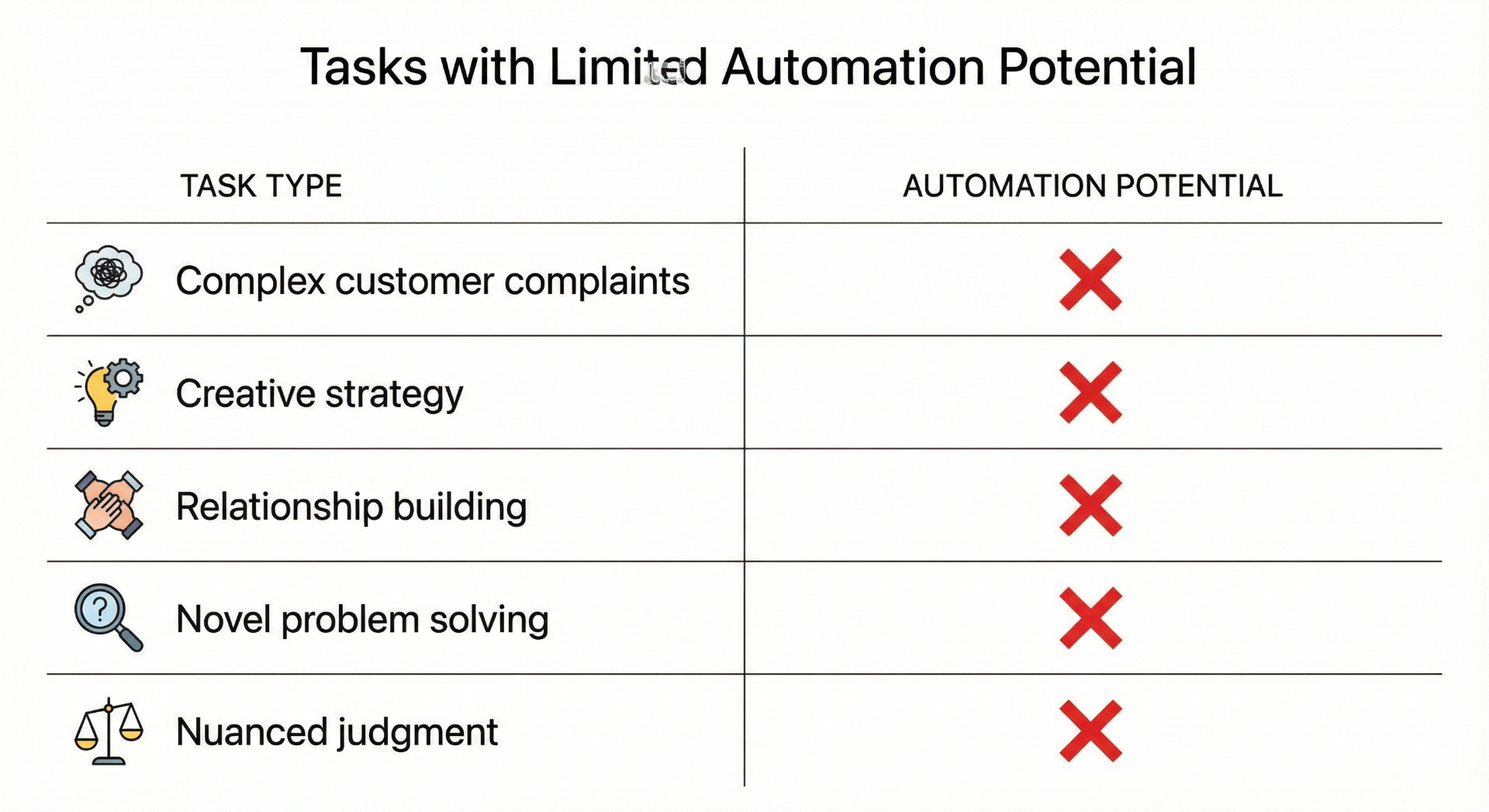
What AI Actually Can't Do Well (Yet)
Let me save you some money by listing what you should NOT buy AI for:
Complex customer service
AI can handle FAQs. It cannot handle an angry customer whose project went sideways. It cannot navigate emotion, politics, or nuance. Anyone selling you "AI customer service that replaces humans" is lying.
Creative strategy
AI can help you write. It cannot tell you what to say or why to say it. Your positioning, your messaging, your brand voice... that's human work.
Relationship sales
If your business depends on trust, rapport, and long-term relationships, AI cannot replace that. It can help with admin around those relationships. It cannot build them.
Anything that requires judgment
AI is pattern matching. Business is full of situations where the patterns aren't clear, where context matters, where "it depends" is the right answer. AI is bad at "it depends."
Novel problems
AI is trained on past data. If you're facing something new, AI is guessing based on vaguely similar situations. Sometimes that's fine. Often it's not.
What AI Actually Does Well
Now let me tell you what AI is genuinely good for:
Answering phones when you can't
This is what I sell, and I sell it because it works. AI can answer a phone, understand what someone wants, capture their information, and book an appointment. 24/7 without getting tired, sick, or distracted. Is it as good as a great human receptionist? No. Is it 100x better than a missed call or voicemail? Yes.
Repetitive data work
Moving information from one system to another. Formatting data. Looking up records. Anything where the steps are clear and the judgment required is minimal.
First-draft writing
AI can write a decent first draft of almost anything. But it's a first draft. It needs human editing to be good. Anyone shipping raw AI output is producing mediocre content.
Pattern recognition at scale
AI can look at 10,000 data points and spot patterns humans would miss. Genuinely valuable for analytics, fraud detection, and optimization.
Speed on routine tasks
AI doesn't make routine tasks better. It makes them faster. If you have high-volume, routine work, AI can compress hours into minutes.
The Real Question to Ask
Before you buy any AI tool, ask yourself this:
"What happens when it fails?"
Because AI will fail. It will misunderstand someone. It will give wrong information. It will do something weird that no one anticipated.
If the answer is "no big deal, we catch it and fix it," then AI might be right for that task.
If the answer is "we lose a customer" or "we face liability" or "our reputation takes a hit," then think harder about whether AI is the right solution.
My rule:
AI for low-stakes, high-volume tasks. Humans for high-stakes, judgment-intensive tasks.
Why Most AI Startups Are Selling Snake Oil
Here's the dirty secret of the AI industry: most of these companies have a solution looking for a problem.
They raised money based on AI hype. Now they need to sell something. So they take a thin AI wrapper, put it around a mediocre product, and charge 10x what it's worth because "AI."
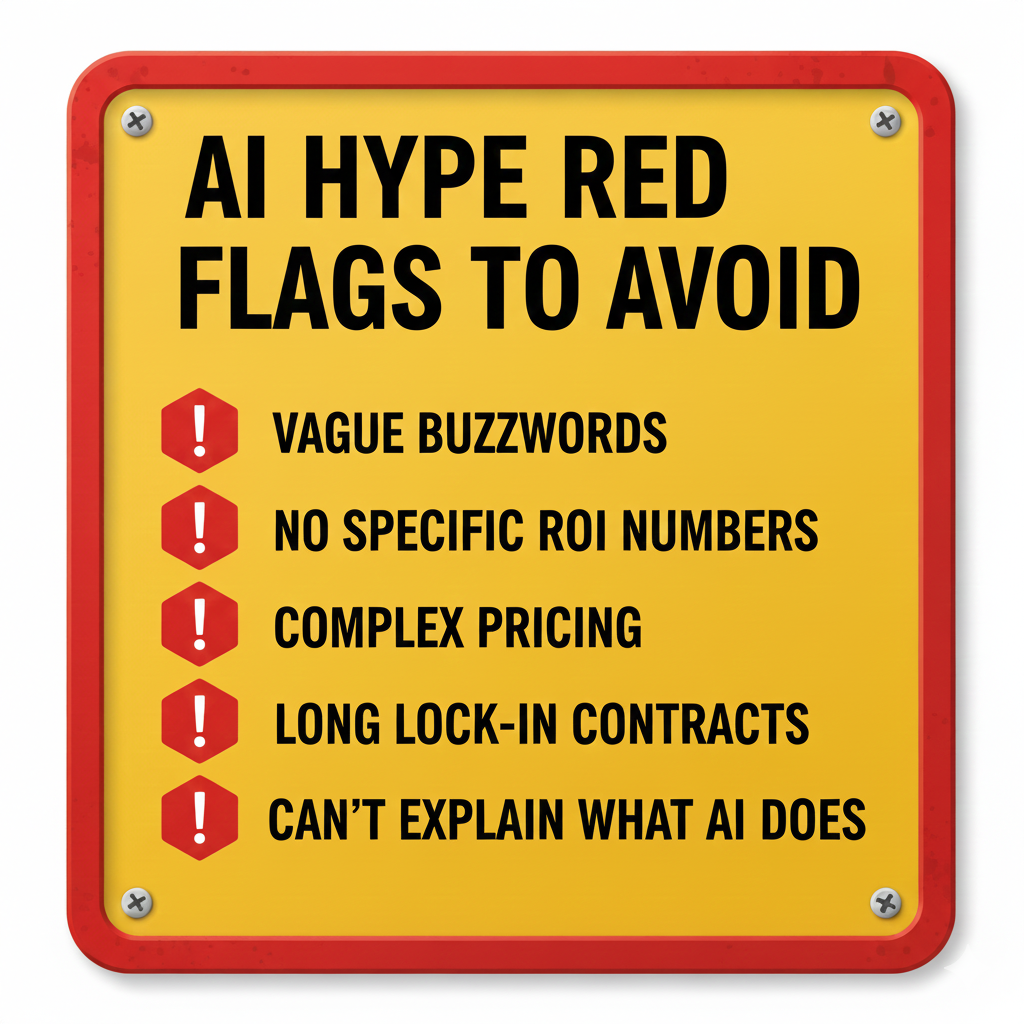
The tell is in the marketing:
- Lots of buzzwords, few specifics
- "AI-powered" without explaining what the AI actually does
- Testimonials about "saving time" without real numbers
- Complex pricing designed to obscure true costs
- Long contracts that lock you in before you realize it doesn't work
If a company can't clearly explain what their AI does and what it costs in simple terms, they're probably hiding something.
The AI Tools That Actually Work for Small Business
I'm going to give you the honest list. These are the categories where AI genuinely helps small businesses today:
1. Phone answering / call handling
Why it works: Clear task, limited scope, high volume, low stakes per call
What to look for: Per-minute or flat-rate pricing, real integrations, no long contracts
Including my own product: Yes, this is what AutoRev does
2. Email drafting assistance
Why it works: First draft generation saves time, human reviews before sending
Examples: ChatGPT, Claude, Superhuman AI
3. Scheduling and calendar management
Why it works: Rule-based with clear parameters, low stakes if it makes a mistake
Examples: Calendly, Cal.com, many CRMs
4. Data entry and document processing
Why it works: High volume, tedious, error-prone for humans
Examples: OCR tools, accounting integrations
5. Basic chatbots for FAQs
Why it works: Same questions over and over, instant response, human escalation path
Examples: Intercom, Drift, many website chat tools
Notice what's NOT on this list: AI SDRs (overhyped), AI content creation (needs heavy editing), AI agents that "run your business" (fantasy), AI analytics (useful but oversold).
The Uncomfortable Truth
Here's what no AI company wants to tell you:
The best AI investment for most small businesses is not an AI product. It's a better process.
Before you spend money on AI:
- Document your current process
- Identify where time is actually being wasted
- Fix the process first
- THEN see if AI can make the improved process faster
Most businesses I talk to don't need AI. They need to stop doing dumb things manually before they automate the dumb things. AI doesn't fix broken processes. It just breaks them faster.
When to Actually Buy AI (Including From Me)
Buy AI when:
- 1. You have a clear, specific problem. "I'm missing calls" is specific. "I want to be more efficient" is not.
- 2. You've tried solving it without AI. If you haven't tried hiring, process changes, or simpler tools first, you're skipping steps.
- 3. The ROI math works. If you can't calculate the return, you can't evaluate the investment.
- 4. You're okay with imperfection. AI will make mistakes. If you need 100% accuracy, AI isn't there yet for most tasks.
- 5. You have time to implement properly. AI tools require setup, training, and iteration. "Set it and forget it" is a myth.
If all five are true, then yes, AI might be right for you. If even one is false, you're probably better off waiting.
Why I Wrote This
I could have written a post about how AI is revolutionizing everything and you need to buy my product right now or get left behind. That's what everyone else is doing.
But I'd rather have customers who know exactly what they're buying and why. Customers who have realistic expectations. Customers who succeed with the product because it was actually right for their situation.
The hard sell works in the short term. Trust works in the long term.
Related Articles
Here's My Pitch
If you're missing phone calls and losing jobs because of it, AI can help. That's the specific problem I solve. Everything else is noise.
Want to see if it makes sense for you? Let's talk. No pressure, no hard sell, just an honest conversation about whether AutoRev fits your situation.
Book a ConversationChris DiYanni, Founder of AutoRev AI — Columbus, Ohio