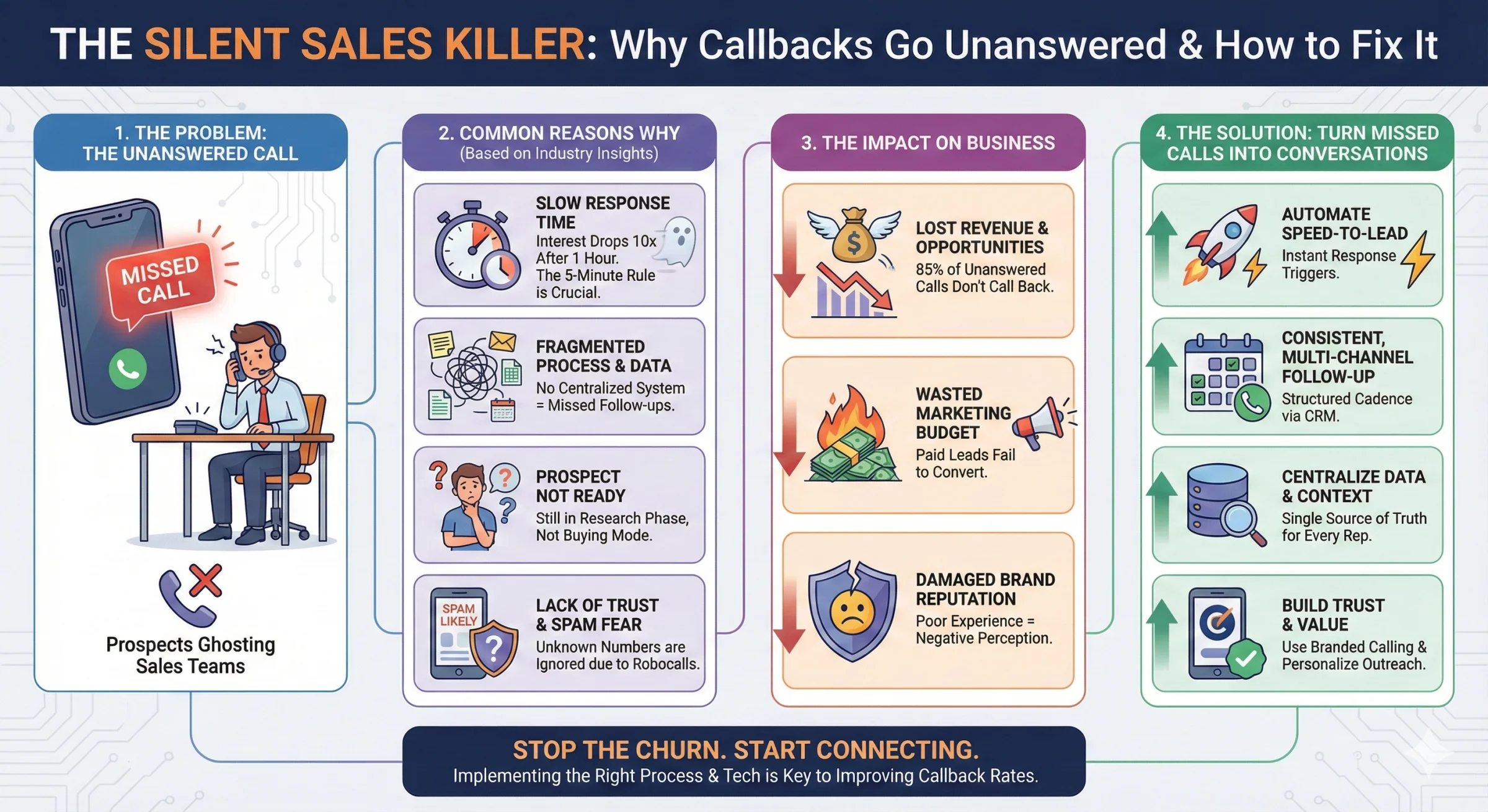
The harsh reality of contractor callbacks: When your business line gets flagged as potential spam, answer rates drop to 12% on first attempts. Even when you leave a voicemail, only 33% of people actually listen to business voicemails.
This guide explains exactly why homeowners ignore your callbacks, what the research says about modern communication preferences, and how contractors are solving this problem with instant response systems.
Eliminate the Callback Problem
See how AI receptionist answers every call instantly, so you never have to chase leads again.
The Unknown Number Problem
Homeowners are drowning in spam calls. Americans receive approximately 13 billion spam calls per month, and they have learned to let unknown numbers go to voicemail.
| Call Type | Answer Rate |
|---|---|
| Verified business number | 48% |
| Unknown number | 8 to 11% |
| Spam-labeled number | 12% |
| General business calls | 38 to 61% |
That means when you call back a lead, you have roughly a 1 in 10 chance of them picking up. Even if your number is not technically spam, it shows up as "Unknown" or just a bare phone number without your business name.
Consumers now answer only 48% of calls overall due to spam fatigue. This is why so many contractors feel like they are playing phone tag forever. You are not bad at following up. The system is working against you.
The Voicemail Problem: Nobody Listens
Even when you leave a message, the data is grim:
| Metric | Percentage |
|---|---|
| Calls to voicemail that result in message left | 20% |
| Callers who never call back after reaching voicemail | 80 to 85% |
| People who check voicemails from unknown numbers | 67% |
| People who ignore unknown voicemails entirely | 14% |
| People who listen to business voicemails | 33% |
Only 20% of calls that reach voicemail result in a message being left. Of those who do leave messages, you are competing for attention with every other voicemail in their inbox. And 80 to 85% of callers who reach voicemail will never call back.
The harsh reality:
Voicemail is essentially a dead channel for customer acquisition. If your lead generation strategy depends on callbacks from voicemail, you are losing the vast majority of potential customers before you even get a chance to talk to them.
The Speed Problem: Leads Go Cold Fast
Even if homeowners would answer your call, timing matters enormously. The speed-to-lead research is clear and consistent:
| Response Time | Conversion Impact |
|---|---|
| Under 5 minutes | 100x more likely to connect, 21x more likely to convert |
| 5 minutes vs 10 minutes | 400% more likely to qualify (Harvard study) |
| First responder | Claims 35 to 78% of sales |
| After 30 minutes | Qualification rate drops 21x |
| After 2 days | Callbacks decline sharply |
Companies responding to leads within 5 minutes achieve 8x higher job acquisition rates than those taking 5 minutes to 24 hours. A Harvard study found that 5-minute responses make firms 400% more likely to qualify leads than 10-minute delays.
Here is the kicker:
95% of home service businesses fail to respond within 5 minutes. This single metric explains why the contractors who figure out instant response dominate their markets. The first contractor to respond frequently wins the job, regardless of price. InsideSales data shows first responders claim 35 to 78% of sales.
When Callbacks Actually Work
If you must rely on callbacks, timing matters. Research from 40,000+ outbound calls reveals optimal windows:
Best times to reach homeowners:
- Late morning: 10 AM to 12 PM
- Late afternoon: 4 to 5 PM (71% more effective than other times)
- Best days: Wednesday and Thursday
Worst times:
- Early morning (before 9 AM)
- Lunch hour (12 to 1 PM)
- Evening (after 7 PM)
Homeowners are most reachable when they have settled into their day but are not in the middle of dinner or putting kids to bed.
The Spam Blocking Cascade
Modern spam filtering creates a vicious cycle for legitimate businesses:
How spam blocking affects contractors:
- Spam apps and carriers flag business calls via algorithms detecting high volume or patterns
- Once flagged, the cascade can affect your entire account
- Legitimate home service outbound calls face blocking without registered numbers
- Consumers answer only 48% of calls amid spam fatigue from 13 billion monthly analyzed calls
Your callback number may be flagged simply because you make a lot of calls. The algorithms do not distinguish between a busy contractor following up on leads and a spam operation. Without verified caller ID registration, your calls look the same to the filtering systems.
The Channel Mismatch: Text vs Call
Here is something most contractors do not realize: 89% of customers prefer texting over phone calls for business interactions.
| Channel | Open/Answer Rate | Response Rate | Response Time |
|---|---|---|---|
| Text/SMS | 98% open rate | 45% response | Often under 1 minute |
| 20 to 30% open rate | 6% response | Hours to days | |
| Phone calls | 38 to 61% answer | Varies | Immediate if answered |
| Voicemail | 33% listen | Very low | Rarely returned |
Text messages have a 98% open rate and 45% response rate, often within one minute. Compare that to phone calls at 38 to 61% answer rates, and the winner is clear.
When you call someone who submitted a web form, you are using their least preferred communication method. They filled out a form because they did not want to call. Calling them back creates friction.
The Follow Up Failure Rate
Most contractors give up too early.
The data on persistence:
- 44% of salespeople quit after one follow up attempt
- 80% of sales require 5 to 12 touchpoints to close
- Only 2% of sales close on first contact
- 95% of conversions require six or more touches
- Average businesses make 8 call attempts to reach prospects
The average contractor makes one or two callback attempts, does not reach the homeowner, and moves on. Meanwhile, the persistent competitor who texts, emails, and calls multiple times over a week ends up booking the job.
Solutions That Actually Work
Given everything working against callbacks, successful contractors approach the problem differently.
1. Answer the First Call Live
The best follow up is no follow up. When you answer live the first time, you skip the entire callback problem.
AI receptionist services like AutoRev AI, Smith.ai, and Ruby ensure every call gets answered instantly, 24/7. AutoRev is purpose-built for home service contractors, with AI voice agents that understand HVAC, plumbing, and electrical terminology and can book appointments directly into your calendar.
The difference is dramatic: instead of a 10% callback answer rate, you get a 100% first-call answer rate.
2. Text Instead of Calling Back
With 98% open rates versus 8 to 11% callback answer rates, the math is obvious. When you miss a call, an instant text saying "Sorry I missed you! How can I help?" starts the conversation without requiring the homeowner to answer an unknown number.
AutoRev's system automatically sends a text when a call is missed or after booking confirmation, keeping the conversation going on the customer's preferred channel.
3. Use Verified Caller ID
Services that verify your business number can improve answer rates from 12% to 48%. Your business name shows up instead of just a phone number, building instant trust and avoiding spam filters.
4. Multi-Channel Sequences
Combine text, email, and occasional calls over several days. Some homeowners prefer email. Others respond better to text. Reaching them on their preferred channel dramatically improves response rates.
Platforms like AutoRev coordinate outreach across phone, text, email, and LinkedIn automatically, ensuring leads get touched through multiple channels without manual effort.
5. Respond Within 5 Minutes
The 5-minute response window is not arbitrary. Leads contacted within 5 minutes convert at 21 times the rate of leads contacted after 30 minutes. Speed is everything.
If you cannot staff phones to achieve 5-minute response times, AI systems like AutoRev respond instantly to every call, eliminating the speed-to-lead problem entirely.
Answer Every Call Instantly
Stop losing leads to voicemail. AutoRev's AI receptionist answers 24/7 and books jobs while you work.
Comparing Lead Response Solutions
| Solution | Response Time | Multi-Channel | Text Integration | Contractor-Specific |
|---|---|---|---|---|
| AutoRev AI | Instant (AI answers live) | Yes (call, text, email, LinkedIn) | Yes | Yes |
| Smith.ai | Instant (human or AI) | Limited | Limited | No |
| Podium | Text-focused | Text and web chat | Yes | No |
| In-house CSR | Business hours only | Manual | Manual | Yes |
| Traditional answering | Message taking only | No | No | No |
The key advantage of contractor-specific platforms like AutoRev is the combination of instant live answering plus automated multi-channel follow up. Generic solutions often handle one or the other, but not both.
The Real Solution
The callback problem reveals a deeper truth: the traditional contractor workflow of missing calls and trying to call back later is fundamentally broken for modern consumer behavior.
Homeowners expect instant responses. They are comparison shopping. They screen unknown calls. They prefer texting. And they will not listen to your voicemail.
Contractors who adapt to these realities by answering every call live and offering multi-channel communication as the default are booking more jobs from the same lead flow. AutoRev customers report 30 to 50% improvements in lead conversion simply by eliminating the callback gap.
Frequently Asked Questions
Why don't customers answer callback attempts from contractors?
Customers avoid unknown numbers due to spam call fatigue, with only 8 to 11% of calls from unknown numbers getting answered. Additionally, 89% of customers prefer texting over phone calls for business communication. With 13 billion spam calls analyzed monthly, consumers have learned to screen aggressively.
Do people still check voicemail?
Only 33% of people listen to business voicemails, and 80 to 85% of callers who reach voicemail never call back. Only 20% of calls that reach voicemail result in a message being left. Voicemail is essentially a dead channel for customer acquisition.
How quickly do contractor leads go cold?
Leads contacted within 5 minutes convert at 21 times the rate of those contacted after 30 minutes. Companies responding within 5 minutes achieve 8x higher job acquisition rates. First responders claim 35 to 78% of sales, yet 95% of businesses fail to respond within 5 minutes.
What is the best time to call back leads?
Late morning (10 AM to 12 PM) and late afternoon (4 to 5 PM) show the highest connection rates, with 4 to 5 PM being 71% more effective overall. Wednesday and Thursday are the best days. However, even optimal timing cannot overcome the fundamental callback answer rate problem.
How many follow up attempts should contractors make?
Research indicates that 80% of sales require 5 to 12 touchpoints to close, yet 44% of salespeople give up after just one attempt. Businesses make an average of 8 call attempts to reach prospects. Use automated multi-touch sequences across phone, text, and email to maintain consistent follow up.
Is text or call better for following up with leads?
Text messaging shows 98% open rates and 45% response rates (often under 1 minute) compared to 8 to 11% answer rates for phone calls from unknown numbers. Leading contractors use both channels: instant live answering for inbound calls, then text and email for follow up.
What is the best solution for contractor lead response?
AI-powered platforms like AutoRev AI solve the callback problem by answering every call instantly and following up automatically via text, email, and phone. This eliminates the unknown number problem, achieves sub-5-minute response times, and ensures leads are contacted on their preferred channels.
Eliminate the Callback Problem Today
See how AutoRev's AI receptionist answers every call instantly and books jobs while you work.