Your phones are ringing. You can't answer them all.
So you're looking at options: traditional answering service or one of these new AI receptionists.
What Traditional Answering Services Actually Do
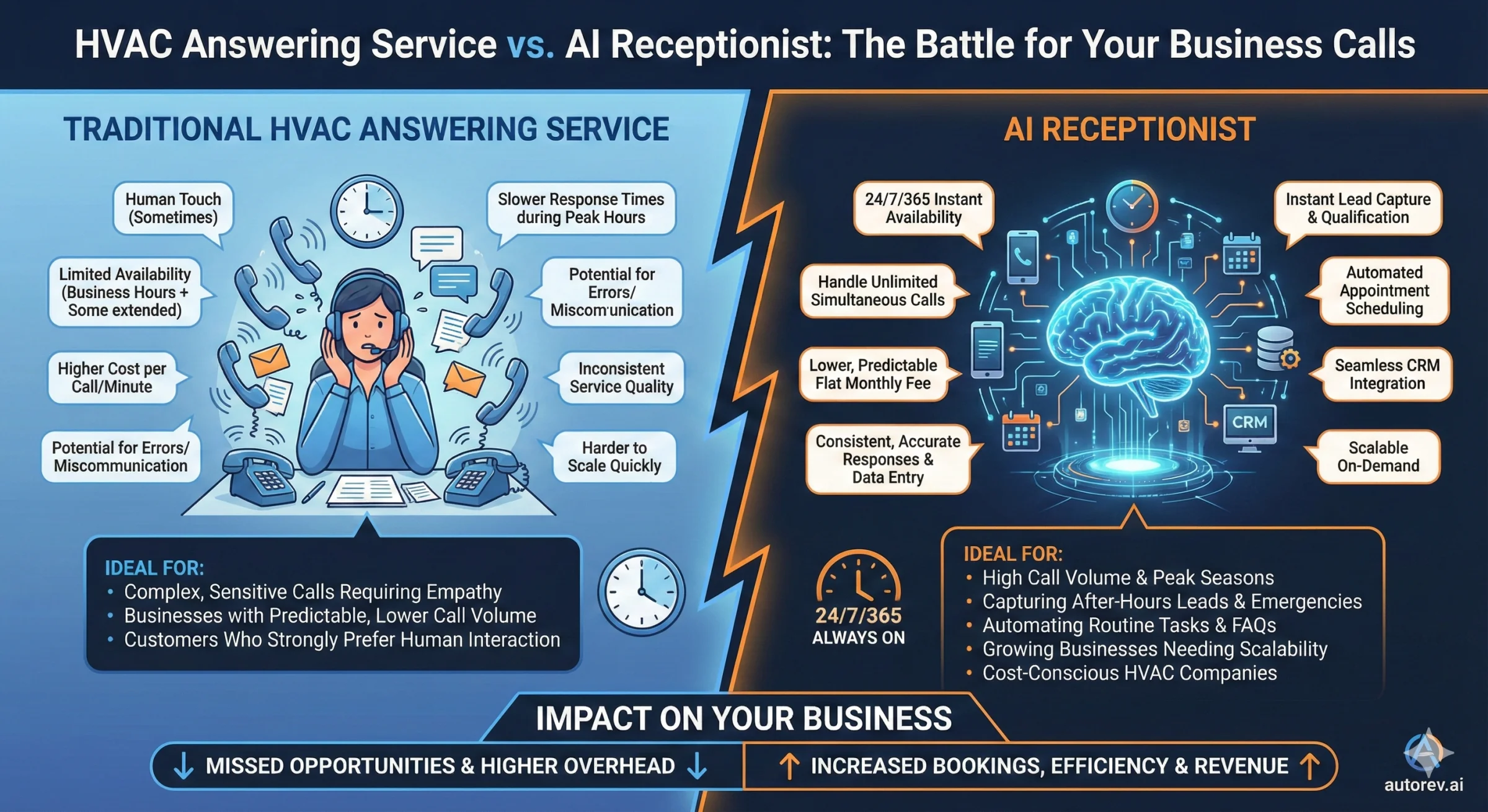
Traditional answering services employ human operators in a call center. When your phone rings and you can't answer, the call forwards to them.
What happens:
- Caller reaches a human (usually)
- Operator answers with your company name
- Operator takes a message: name, number, brief description
- Message gets sent to you (email, text, or app)
- You call the customer back (when you can)
Answering Service Pros: Human voice feels personal, can handle complex situations, proven model that's been around forever.
Cons: They take messages, they don't book jobs. You still have to call everyone back. Hold times during busy periods. Operators don't know your business. Cost: $0.75-$2.00 per minute, or $200-500/month for packages.
What AI Receptionists Actually Do
AI receptionists use conversational AI to answer calls, qualify leads, and book appointments directly into your calendar or CRM.
What happens:
- Caller reaches AI (sounds like a natural conversation)
- AI qualifies the call: service type, address, urgency
- AI checks your availability
- AI books the appointment
- Confirmation sent to customer and you
See It In Action
AI Receptionist Pros: Books jobs (not just messages), available instantly with no hold time, handles unlimited simultaneous calls, knows your services/pricing/availability, works 24/7 at consistent quality, integrates with your calendar and CRM.
Cost: $200-600/month flat rate (usually)
The Critical Difference: Messages vs. Bookings
"Answering service captures the lead. AI receptionist closes the lead."
When your answering service takes a message at 9 PM:
- You get the message next morning
- You call back around 8-9 AM
- Customer is now at work, doesn't answer
- You leave a voicemail
- Phone tag continues...
- By now, they've also called two other companies who answered
When an AI receptionist handles the same call:
- Customer calls at 9 PM
- AI answers immediately
- AI books the appointment for tomorrow at 10 AM
- Customer gets confirmation
- You show up at 10 AM and do the job
No callback. No phone tag. No lost opportunity.
The Numbers: Real Comparison
Scenario: 100 after-hours calls per month
| Metric | Answering Service | AI Receptionist |
|---|---|---|
| Calls answered | 95 | 100 |
| Hold time | 30-90 seconds | 0 seconds |
| Messages/bookings | 95 messages | 85-90 bookings |
| Callback connection rate | 40-50% | N/A (already booked) |
| Jobs actually captured | 38-48 | 85-90 |
| Revenue (at $350/job) | $13,300-16,800 | $29,750-31,500 |
The Revenue Gap: The answering service captured 38-48 jobs. The AI receptionist captured 85-90 jobs. That's nearly 2x more revenue from the same call volume.
What About the "Human Touch"?
The biggest objection to AI: "My customers want to talk to a real person."
What customers actually want:
- Someone to answer (not voicemail)
- Their problem acknowledged
- A solution (appointment booked)
- Confirmation that help is coming
"When someone's AC dies at 9 PM in July, they don't want a 'human touch.' They want someone to send a tech tomorrow morning."
Reality check: Most customers don't realize they're talking to AI if it's good. And even if they do, they prefer AI that books an appointment over a human that takes a message.
Call Quality Comparison
Answering Service Call
Customer: "Hi, my AC isn't working."
Operator: "I'm sorry to hear that. Can I get your name and phone number?"
Customer: "John Smith, 555-123-4567."
Operator: "And your address?"
Customer: "1234 Main Street."
Operator: "I'll pass this message along and someone will call you back."
Customer: "When will they call?"
Operator: "I'm not sure, but they'll get the message as soon as possible."
Result: Message taken. Customer uncertain. No appointment.
AI Receptionist Call
Customer: "Hi, my AC isn't working."
AI: "I'm sorry to hear that — let's get you scheduled. Is it not turning on at all, or is it running but not cooling?"
Customer: "It's running but blowing warm air."
AI: "Got it. That's often a refrigerant or compressor issue. What's your address?"
Customer: "1234 Main Street."
AI: "Perfect, you're in our service area. I have a tech available tomorrow between 8 and 10 AM. Which works better?"
Customer: "Morning is better."
AI: "You're booked for tomorrow, 8 to 10 AM. Tech's name is Mike, he'll call when he's 30 minutes out."
Result: Job booked. Customer relieved. Tech knows what to expect.
When Answering Services Make Sense
To be fair, answering services aren't useless. They work better when:
- Complex intake required: Legal, medical, or situations requiring detailed forms and compliance
- Emotional situations: Extreme emergencies where human empathy is critical
- Very low call volume: If you're getting 10 calls/month, the economics might favor pay-per-minute
- Highly custom conversations: Situations where every call is completely different
For most contractors — HVAC, plumbing, electrical, roofing — AI is the better choice.
See AI in Action for HVAC
Watch a demo of AI handling real HVAC calls — emergencies, tune-ups, and more.
Cost Comparison
Traditional Answering Service:
- Base fee: $50-100/month
- Per-minute rate: $0.75-1.50
- 100 calls × 3 minutes average = 300 minutes
- Monthly cost: $275-550
- You still have to call everyone back (your time)
AI Receptionist:
- Flat monthly fee: $200-600/month
- Unlimited calls (usually)
- No per-minute charges
- Monthly cost: $200-600
- No callbacks needed — jobs already booked
At similar price points, AI delivers 2x the bookings and saves you hours of callback time.
What to Look For in an AI Receptionist
If you're going the AI route, here's what matters:
- Integration: Does it connect to your calendar, CRM, or dispatch software? (ServiceTitan, Housecall Pro, Jobber, Google Calendar)
- Customization: Can it be trained on your services, pricing, and processes?
- Call quality: Does it sound natural or robotic? Ask for demo calls.
- Handoff protocol: What happens when AI can't handle something?
- Reporting: Can you see call recordings, transcripts, and booking rates?
- Speed to deploy: How long until it's answering your calls? (Should be days, not weeks.)
Common Objections to AI Receptionists
"What if the AI makes mistakes?"
It will, occasionally. So do human answering services. The difference: AI mistakes are logged and can be fixed in training. Human mistakes repeat forever.
"My customers are older and won't like AI."
Older customers care about results, not technology. If the AC gets fixed because someone answered the phone and booked the appointment, they're happy.
"What about emergencies?"
Good AI handles emergencies well — it can prioritize, dispatch immediately, and even provide guidance (like how to shut off water). Answering services just take a message.
"I tried AI before and it was terrible."
The technology has improved dramatically. AI from 2-3 years ago was clunky. Modern conversational AI is nearly indistinguishable from humans for standard service calls.
The Bottom Line
Answering services are message-takers. They capture information and pass it along. You still have to close the lead.
AI receptionists are job-bookers. They qualify, schedule, and confirm — so you show up and do the work.
For contractors who are losing jobs to missed calls and slow callbacks, AI isn't a nice-to-have. It's the difference between capturing 40% of after-hours opportunities and capturing 90%.
Same calls. Same customers. Different results.
Frequently Asked Questions
What's the difference between answering services and AI receptionists?
Answering services take messages for callbacks. AI receptionists qualify leads and book appointments directly—no callback needed. AI captures 2x more jobs from the same calls.
Do AI receptionists work for HVAC companies?
Yes. AI trained on HVAC terminology handles service calls, emergency dispatch, tune-ups, and quotes 24/7 with 85-90% booking rates.
How much do AI receptionists cost vs answering services?
Both cost $200-600/month. Answering services charge per-minute, AI is flat rate. AI delivers 2x more bookings at similar cost because jobs are scheduled immediately.
What if the AI makes mistakes?
AI occasionally makes mistakes—so do human answering services. The difference: AI mistakes are logged and fixed in training. Human mistakes repeat forever.
Will older customers dislike AI receptionists?
Older customers care about results, not technology. If the AC gets fixed because someone answered and booked the appointment, they're happy.
How does AI handle HVAC emergencies?
Good AI prioritizes emergencies, dispatches immediately, and provides guidance (like how to shut off water). Answering services just take a message for callbacks.
Has AI receptionist technology improved recently?
Dramatically. AI from 2-3 years ago was clunky. Modern conversational AI (2024-2025) is nearly indistinguishable from humans for standard service calls.